


 Inversiones Maslosa / Insights / Blog / Times of War
Blog
Diversification, Profitability and Added Value
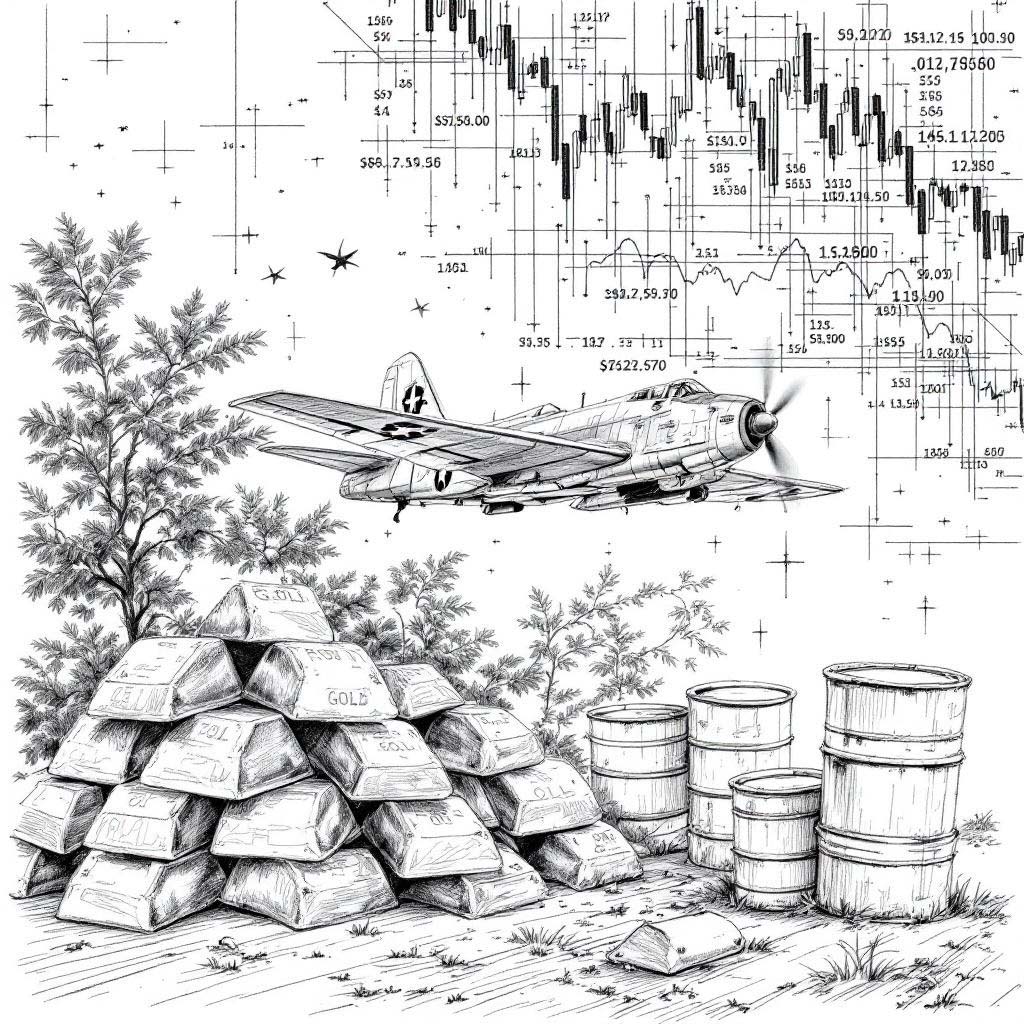
THE FALSE NORMALITY OF MARKETS IN TIMES OF WAR.
The Pattern That Repeats in Every Conflict.
Financial markets have a remarkable ability to adapt to almost any circumstance. Political crises, trade tensions, or armed conflicts often trigger immediate reactions: stock market declines, spikes in strategic commodities and capital flows toward assets perceived as safer. However, after this initial adjustment, a reassuring narrative usually emerges that begins to dominate investor discourse: the idea that everything will soon return to normal.
The problem is that this perception of normality can be misleading. History shows that some international conflicts leave barely a trace on markets, while others permanently reshape the global economic balance. The real challenge for investors is not surviving the first weeks of volatility, but understanding whether they are facing a temporary episode or the beginning of a deeper economic transformation.
The Automatic Reaction of Investors.
When a geopolitical crisis erupts, markets tend to respond with a fairly predictable pattern. First comes the mass sell-off of assets considered risky, particularly equities in cyclical sectors such as discretionary consumption, tourism, or industry. Uncertainty about economic growth prompts investors to reduce exposure to businesses most sensitive to the economic cycle.
At the same time, capital shifts toward defensive sectors or assets traditionally perceived as safe havens. The priority shifts from maximizing returns to preserving capital.
This behavior is not irrational. In an environment of extreme uncertainty, reducing risk is a logical reaction. However, the problem arises when the market too quickly assumes that the shock has been absorbed.
Recent history has reinforced this tendency. For years, every significant correction has ultimately found support in expansionary monetary policies or in the resilience of the global economy. This has generated an implicit confidence that markets will always stabilize relatively quickly.
The Real Transmission Channel: Energy.
In most significant international conflicts, the decisive factor is not military but economic. And within the economy, the most sensitive element is usually energy.
Oil and gas remain fundamental pillars of the global production system. Any threat to their supply introduces an extremely complex variable for markets: imported inflation. When energy prices surge, the effect quickly spreads to transportation, industry, food and ultimately the entire economy.
This creates a particularly uncomfortable dilemma for central banks. If inflation rises due to energy shocks while growth weakens, monetary policy becomes trapped between two conflicting objectives: containing prices or supporting economic activity.
That scenario —elevated inflation combined with slowing growth— is one of the most challenging environments for financial assets.
The Risk the Market Seems to Ignore.
In recent decades, the classic diversification between equities and bonds has become widely accepted as a mechanism to protect investment portfolios. When the economy cools, bonds typically rise while equities fall, balancing overall risk.
But in a prolonged energy crisis, that relationship can break down.
If inflation increases due to rising energy prices, bonds suffer because interest rates must remain high. At the same time, companies face higher costs and shrinking profit margins, which also puts pressure on equities.
This is when the real problem for investors appears: the possibility that both asset classes decline simultaneously.
These episodes are relatively rare, but when they occur they create a strong sense of vulnerability in the markets, because many portfolios are built precisely on the assumption that this negative correlation will hold.
Sectors That Show Greater Resilience in Times of Tension.
In periods of prolonged geopolitical uncertainty, some sectors tend to demonstrate greater resilience.
Industries linked to security and defense often benefit from increased military spending. The need to strengthen strategic capabilities usually translates into larger public budgets and stable long-term contracts.
The energy sector also gains prominence. When commodity prices rise, producing companies often improve their revenues and cash generation. However, their performance depends heavily on the duration of the energy cycle and on expectations for global demand.
On the other hand, there are traditionally defensive sectors whose stability becomes particularly attractive during uncertain times: utilities, healthcare and food production. These industries depend on essential needs, making their demand relatively stable even when the broader economy faces difficulties.
Safe-Haven Assets… and Their Limits.
In periods of international tension, capital tends to move toward assets considered safe havens. Gold, certain strong currencies and some sovereign bonds have historically played this role.
However, these instruments are not immune to market cycles. When uncertainty rises rapidly, flows into safe-haven assets can push their prices up so sharply that their subsequent protective margin diminishes.
Moreover, if the underlying problem is inflationary —as in an energy crisis— even some traditional safe havens can behave less predictably.
This reinforces a key conclusion: no asset provides absolute protection against a systemic shock.
The Real Strategy in Times of Uncertainty.
In moments of geopolitical tension, the biggest mistake investors tend to make is reacting impulsively to headlines. Wars generate extreme narratives —either catastrophic or complacent— and both often lead to hasty decisions.
Market history shows that corrections triggered by geopolitical crises often also create opportunities. But identifying them requires a different perspective: focusing on the quality of assets and their ability to withstand different economic scenarios.
Companies with strong balance sheets, clear competitive advantages and stable cash generation tend to recover sooner once conditions normalize. And above all, a portfolio diversified across sectors and regions remains the most effective tool for navigating periods of uncertainty.
The Lesson the Market Has Yet to Learn.
The fundamental question is not where to invest during a war, but how to correctly interpret the risk it represents.
Markets tend to make mistakes at two moments: first, they react with panic to the initial surprise; then, they tend to underestimate the true duration of the economic consequences.
The current challenge may lie precisely in this second error. If the conflict persists and ultimately affects global energy stability, the impact on inflation, growth and monetary policy could be far deeper than what asset prices currently reflect.
And when markets are forced to adjust structural expectations —not just headlines— volatility ceases to be a temporary episode and instead becomes a new phase of the financial cycle.
Strategic Recommendation for Investors.
One of the key lessons from episodes of geopolitical tension is that the market’s initial reaction is often emotional, while the real economic consequences tend to unfold much more slowly. For this reason, investors who aim to act with professional discipline should avoid making decisions based solely on the immediate snapshot of market prices.
In contexts like the current one, the priority should not be trying to anticipate every market movement, but rather reassessing the structure of the portfolio under a scenario of greater macroeconomic uncertainty. When a conflict has the potential to alter structural variables —particularly energy, inflation, or monetary policy— the prudent approach is to assume that the financial environment may remain unstable for longer than markets initially anticipate.
From that perspective, the recommended approach revolves around three clear lines of action.
First, strengthen the overall quality of the assets within the portfolio. During prolonged periods of tension, companies with strong balance sheets, stable margins and the ability to pass rising costs on to consumers tend to prove more resilient. These businesses are generally better equipped to withstand environments characterized by inflation, economic slowdown, or tighter monetary conditions.
Second, reassess the portfolio’s true level of diversification. Many strategies that appear diversified are in fact driven by the same macroeconomic engine: stable growth and moderate interest rates. When that environment shifts, such diversification may prove insufficient. Incorporating exposure to sectors with different underlying dynamics —including those that may benefit from energy cycles or increased strategic public spending— can help balance overall risk.
Finally, maintain discipline in managing both time horizons and liquidity. In periods of heightened volatility, patience becomes a competitive advantage. History shows that the sharpest market adjustments often create opportunities, but only for investors who retain the flexibility to act once prices already reflect excessively pessimistic scenarios.
Ultimately, rather than attempting to predict how the conflict will unfold, investors should focus on building portfolios capable of withstanding multiple potential scenarios. The key is not reacting to the daily noise of the markets, but adapting strategy to an environment in which the stability that dominated financial markets in recent years may give way to a more complex phase, marked by higher volatility and structural changes in the global economy.


WHO WE ARE
WHAT WE DO
INVESTMENT AREAS
INSIGHTS

