


 Inversiones Maslosa / Insights / Press Releases / Pedro Martínez Cutillas (The Historian's Gaze)
Press Releases
Diversification, Profitability and Added Value
Inversiones Maslosa / Insights / Press Releases / Pedro Martínez Cutillas (The Historian's Gaze)Date: 06/09/2022
Category: Press Releases
PEDRO MARTÍNEZ CUTILLAS
IN MEMORIAM
Entrepreneur with a historian soul
Spanish with a Panamanian spirit
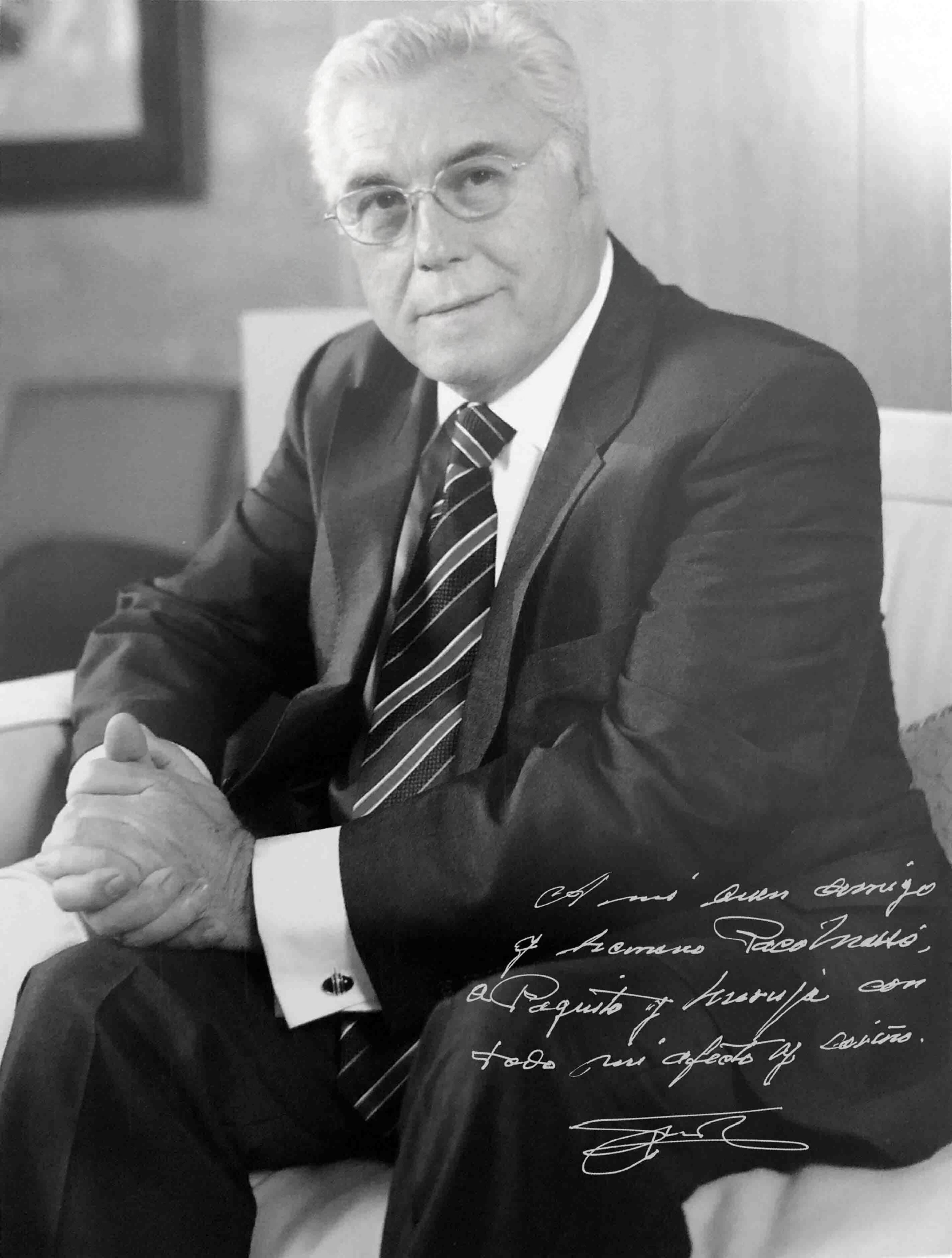
PEDRO MARTÍNEZ CUTILLAS
Owner and Executive President of the EMMSA Group
On October 12, 2006, we had the privilege of receiving, from the hands of Pedro Martínez Cutillas, the first edition of his work Panamá Colonial: Historia e Imagen, freshly published. Within its pages, we also found a handwritten dedication: words brimming with warmth and closeness, an intimate testimony of the deep bond that united us and of the sincere affection he always conveyed.
The publication of this book thus marked the conclusion of a long-shared process, often discussed and closely followed, in which we witnessed the excitement and enthusiasm with which Pedro awaited the completion of a work to which he had devoted years of study, effort and reflection.
His love for Panama was born long before his arrival on the Isthmus. Hailing from Barcelona, he set foot on its shores on a Holy Week day in 1977, unaware that this place would, over the years, become an essential part of his life and his work. That first encounter with Panamanian soil was, at the same time, a challenge and a promise: a commitment to memory, to historical truth and to the spirit of a country that had already taken root in the depths of his heart.
“The country exceeded my expectations. It was not only as I had dreamed, it was more beautiful. Portobelo impressed me; I was also impressed by Isla Grande, its beaches and especially its nights”.
Pedro Martínez Cutillas.
It was that devotion that —driven by the conviction that the colonial past still held untold stories waiting to be discovered —led him to bring together nine individuals who, after four years of intensive work in the Archive of the Indies (2002–2006), carried out one of the most exhaustive studies ever conducted on the subject. By then, he had already accumulated more than three decades of close engagement with and interest in, the Isthmus.
This research, in addition to adhering to rigorous historical and scientific standards, represented the realization of a dream and responded to the abundant affection he had found in Panama, “as in no other place in the world”.
The fruit of this effort took shape in two exceptional books: Colonial Panama: History and Image (2006) and Veragua in the Sixteenth Century: History and Image (2010), works that specialists have described as true gems of Panamanian historiography. Both publications were distributed in non-commercial editions —without profit or commercial intent— by institutions, libraries and universities in Europe and the Americas, with print runs of 1,000 copies in Spanish and 500 in English.
For Pedro Martínez Cutillas, the completion of both books represented a “long-cherished personal dream”, through which he wished to express his “affection and the unfathomable bonds of love” that connected him both to Panama and to his native land, closely intertwined by history.

“Colonial Panama: History and Image” is a monumental work of undeniable bibliographic value and constitutes a mandatory reference for understanding the importance of the Isthmus of Panama in the history of the Kingdom of Tierra Firme during the Hispanic era in the Americas.
With its 637 pages, this work features luxury printing and binding, accompanied by a rich iconography of 600 color images. Its hundreds of illustrations constitute the most valuable complement to its historical and cultural purpose. Every detail in the writing, printing and format pursues a single objective: to convey to the reader the same passion and enthusiasm that inspired its author, as well as his deep love for Panama.
One of the major bibliographic strengths of this work lies in the use of primary documentary sources. Its conceptual framework is based on the study and analysis of 103 documents from the Archivo General de Indias in Seville, a task made possible by a team of professional researchers who carried out the work of heuristics and hermeneutics, ensuring exceptional academic rigor.
“Among all these funds, I would undoubtedly highlight those preserved in the General Archive of the Indies in Seville, General Archive of Simancas, National Historical Archive, Cathedral Chapter of Seville, Colombian Library, Ducal Archive of Alba, Pierpont Morgan Library, the School of Hispano-American Studies in Seville, etc., although there are also numerous private contributions that have generously provided me with valuable documentary and cartographic information”.
Pedro Martínez Cutillas.
A total of 132 fundamental works on Hispanic affairs were consulted, including studies by Panamanian authors, addressing Panama’s relationship with the Spanish Empire, thus offering a global perspective of the Isthmus within the strategy of an empire where the sun never ceased to illuminate its vast territories.
The majestic format of the work perfectly suits its content, allowing readers to appreciate the hundreds of maps, plans, manuscripts, drawings, photographs and paintings that enrich the text with images of singular beauty. It is a historical narrative also expressed iconographically, with the participation of 25 distinguished professional photographers, whose work provides unparalleled visual and documentary value.
A prominent example is the portrait of Rodrigo de Bastidas, the discoverer of Tierra Firme, created specifically for this edition by the renowned portraitist and figurative painter from Málaga, Félix Revello de Toro. This unique piece brings to life one of the most significant figures in colonial history, restoring a face and presence to a name that, for centuries, only existed in texts. Revello’s mastery, marked by his exceptional talent and artistic skill, contributes to a deeper understanding of history through art, in its human and visual dimension.
Now incorporated into our collection, this painting entrusts us with the honor and responsibility of safeguarding its preservation and transmitting its memory. A bridge is thus extended between the literary and the visual, between the past and the present, between the one who conceived it and the one who made it possible; a bond that fills us with profound pride and sincere emotion.


Without being a history manual with the traditional academic rigidity, Colonial Panama: History and Image offers a view of Panama’s development through an engaging narrative, historically accurate in its assessments and with a truly remarkable capacity for synthesis.
The first part, devoted to the conquest, describes the explorations of the Isthmus during the Columbian period, the first governorships in Tierra Firme and the discovery of the South Sea, as well as the territorial expansion platform represented by the Panamanian base once the sixteenth century had begun. The work addresses the relationship with the monarchy, the establishment of the diocese and the kingdom of Panama, the Potosí–Seville circuit, the routes to the South Sea and the attacks of Drake and Morgan, leading into the eighteenth century, marked by the Bourbon reforms and the subordination of the Panamanian enclave to the Viceroyalty of New Granada.
The intense confrontation with the English constitutes a prominent chapter, where military defenses, the organization and discipline of the militias, conflicts of authority between the general command and the four governorships and the emergence of municipal power are analyzed. All of this is presented while highlighting, with exceptional clarity, the role of the Church in these various stages, perhaps as no other author has done.
Monsignor José Dimas Cedeño, Metropolitan Archbishop of the Archdiocese of Panama (1994–2010), wrote in the book’s foreword:
“The author has granted throughout his pages, with rigor and objectivity, a great protagonism to the church and the ecclesiastics in the historical evolution of the Isthmus. And this, apart from satisfying all believers interested in knowing the process of the Gospel diffusion in American soil, also responds to a rigorous historical truth”.
On March 2, 2007, the year marking the 500th anniversary of Christopher Columbus’s death, Pedro Martínez Cutillas presented his work before a distinguished audience, in the shadow of the main cathedral of Panamá La Vieja.
In this exceptional historic site, rich in symbolism, he announced the creation of an international award inspired by two fundamental pillars of colonial Panama. This prize, open to national and international authors, would not only confer a valuable financial recognition but also ensure the publication, dissemination and distribution of the winning works within the most influential academic and literary circles.
However, this achievement was not enough for someone who always sought to deepen his understanding of the Isthmus’s history. Driven by his inexhaustible curiosity and affection for the country, Pedro Martínez Cutillas continued his historiographical work, pushing beyond the limits of his own accomplishment.
In doing so, he paid, in his own words, a “heartfelt tribute to the Republic” with the 2010 publication of “Veragua in the Sixteenth Century: History and Image”.
This work became a document of inestimable value for national history, offering historiography a clear and orderly vision of how, throughout the sixteenth century, the geopolitics of the then little-known territory that today constitutes the province of Veraguas were formed.
This new and substantial composition was the result of intellectual effort, investigative discipline and coordination with sources of various kinds. Its pages trace the paths of history all the way to Veragua, narrating its origins and explaining the transition over time, from its division into the Governorship of Veragua, the Duchy of Veragua, the Royal Veragua and finally the Province of Veragua.

“Veragua in the Sixteenth Century: History and Image” arises from the author’s interest in Christopher Columbus’s fourth voyage, particularly regarding the discovery of the Veraguas coastline, the founding of Santa María de Belén in 1503, the admiral’s interest in the region’s gold resources, the undefined boundaries of the province known as Veragua, the resistance of native peoples to conquest, mining exploitation and the subsequent granting of the Duchy of Veragua to Columbus’s descendants.
The book focuses on describing the events that took place in the Veragua region from Columbus’s fourth voyage, when the immense gold wealth of the territory became known, until the end of the sixteenth century. Its content is based primarily on the research, transcription and reproduction of a wide variety of documents —letters, royal decrees, capitulations, among others— preserved in the main Spanish and foreign archives, both state and private.
Pedro Martínez Cutillas highlighted the valuable collaboration of numerous experts, whose work in locating and transcribing sources proved crucial.
Through illustrations, maps, engravings, canvases, castles, churches and other elements, the book immerses the reader —both specialist and general public— into the historical settings of sixteenth-century Veragua.
While reviewing the documentation and images to produce his first book, Colonial Panama: History and Image, he recounted how “new data on Veragua kept appearing, to the point that this territory of the Isthmus became omnipresent. I soon realized that sixteenth-century Veraguan historiography required a special study and from that moment, the idea of writing a book on this region of the Panamanian Isthmus never left my mind”.
Today, “Veragua in the Sixteenth Century: History and Image” is presented as a work spanning 544 pages, bringing together dozens of documents and images, many of them of great artistic value and unique pieces on both sides of the Atlantic.
This publication, like the monograph “Colonial Panama: History and Image”, is intended to be “an original work that, without departing from scientific rigor, would remain accessible to a broader readership”.
Following this principle, the book’s edition was conceived around three fundamental elements. First, a solid text, based on extensive documentation and written clearly and comprehensibly. Second, abundant and original iconography, including an extensive cartographic collection, numerous period documents reproduced as facsimiles, canvases, illustrations and a carefully curated selection of photographs produced specifically for this work. And third, an edition meticulously crafted in every aspect, from design and layout to the choice of paper and leather binding.
Regarding its structure, “Veragua in the Sixteenth Century: History and Image” consists of six chapters describing the most significant events.
Unlike his previous work, Pedro Martínez Cutillas chose to strengthen the research by incorporating two elements at the end of each chapter: a documentary appendix, where the most important documents are reproduced facsimile-style with their full transcriptions and an extensive list of footnotes, designed so as not to distract the reader from the main narrative.
His works reflect dedication, rigorous debate and above all, exhaustive use of previously unpublished documentation, leaving no time or resources spared, thereby offering a panoramic view of Panama’s historical development.
These two volumes stand out for their meticulous and rigorous study, enriched with new interpretations and reflections and constitute one of the most outstanding contributions to national historical literature.
“History is the discipline of “human self-knowledge […] to know oneself means to know what one can do and since no one knows what he can do until he tries, the only clue to know what man can do is to find out what he has done. The value of history, therefore, consists in the fact that it teaches us what man has done and in that sense what man is”.
R. G Collingwood.
To Pedro Martínez Cutillas, in memory of his life and his indelible legacy, an authentic testament to virtue, dedication and example.
Francisco Massó Mora.
RELATED CONTENT

Press Releases


WHO WE ARE
WHAT WE DO
INVESTMENT AREAS
INSIGHTS

